With years of treating diseases and conditions affecting the health of women, such as infertility, in-vitro fertilization (IVF), endometriosis, uterine fibroids, polycystic ovary syndrome (PCOS), dysmenorrhea, Irregular menstruation, premenstrual syndrome (PMS), perimenopause, and menopause, Dr. Zhou has adopted and further developed a Phased Acupuncture Treatment Approach to relieve the clinical symptoms. Here, we will communicate on this.
The physiology of a menstrual cycle
To understand our Phased Treatment Approach, it is essential to discuss the normal physiology of a female’s menstrual cycle, which involves cyclic changes in the uterus, ovaries, and hormones, regulated by the nervous, endocrine, vascular, and immune systems. The menstrual cycle coordinates the functions of the uterus and ovaries so that an egg cell can mature, and a fertilized egg can implant in the uterine lining to produce a pregnancy (Fig. 1).
Usually, a menstrual cycle lasts between 21 and 35 days and has a median of 28 days. In a typical example of a menstrual cycle of 28 days, the menstrual flow phase happens on Day 1 and usually lasts for about 5 days, to shed the impaired endometrium tissue to the outside of the body; the latter is vital to set a good start for the following proliferative phase during which the uterine lining grows in thickness to prepare for potential pregnancy. Such growth of the endometrial lining will continue until ovulation, which happens about Day 14. Meanwhile, the hormone follicle-stimulating hormone (FSH), released by the pituitary gland in the brain, promotes the growth of ovarian follicles to develop a mature egg and the production of estrogen by the ovaries. The produced estrogen, in turn, promotes endometrial growth via cell division, which can reach 8 to 12 mm and prepares for potential embryo implantation if fertilization is successful.
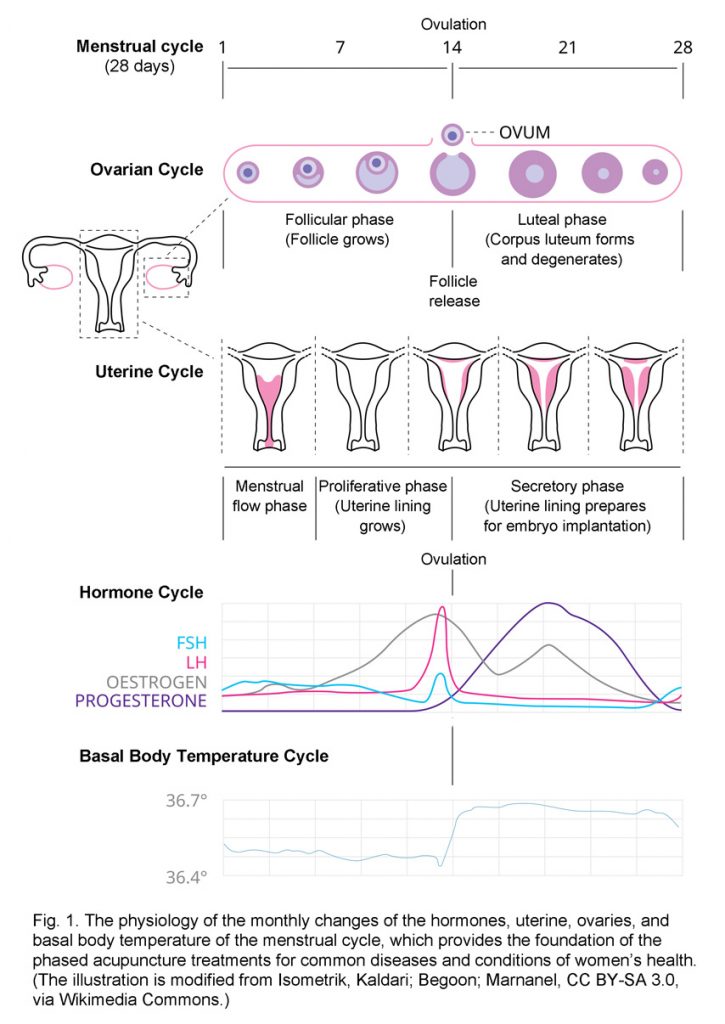
The endometrium reaches its maximal development at the end of the proliferative phase. This is followed by a surge of luteinizing hormone (LH) from the pituitary gland, which triggers the release of the egg cell (oocyte) about 36 hours later. This is the ovulation event, which can be measured by a slight rise in the basal body temperature.
After ovulation, the secretory phase lasts about 14 days until the menstrual bleeding of the next menstrual cycle. During this phase, progesterone is produced in the corpus luteum (derived from the remaining follicle from which the oocyte is released). Progesterone promotes glandular secretion, providing the necessary proteins and energy molecules in the uterine lining to support embryo development.
In conclusion, a regular menstrual cycle and preparation for pregnancy require accurate, timely coordination of multiple organ systems. This highlights the challenge of managing the conditions and diseases related to women’s menstrual cycles. At the same time, the phased cycle of multiple organ systems requires a well-designed acupuncture treatment protocol that considers the distinct nervous, hormonal, vascular, and immune properties of those phases. Hence, the Phased Acupuncture Treatment approach we have adopted and further developed meets this critical requirement in treating women’s health conditions and diseases.
Common acupuncture points used for women’s health
The acupuncture treatment for each condition and disease of women’s health is determined by a treatment protocol that includes the treatment frequency, modality, and selection of a set of acupuncture points. Such a treatment protocol is usually modified throughout the course of treatment to customize each acupuncture session to address different aspects of the symptoms and to achieve further symptom relief based on current progress.
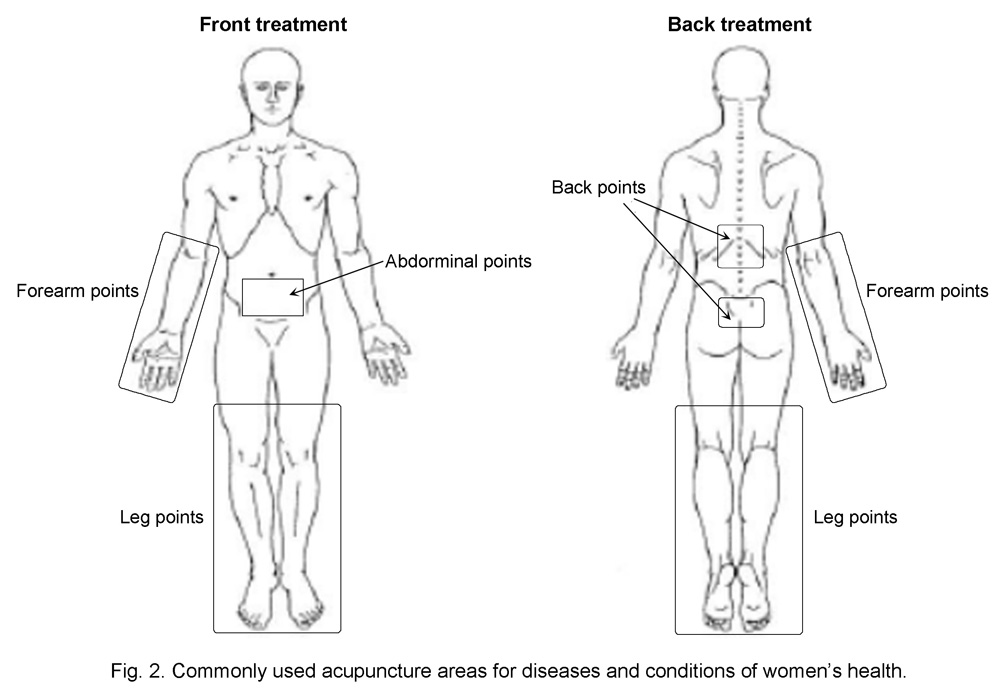
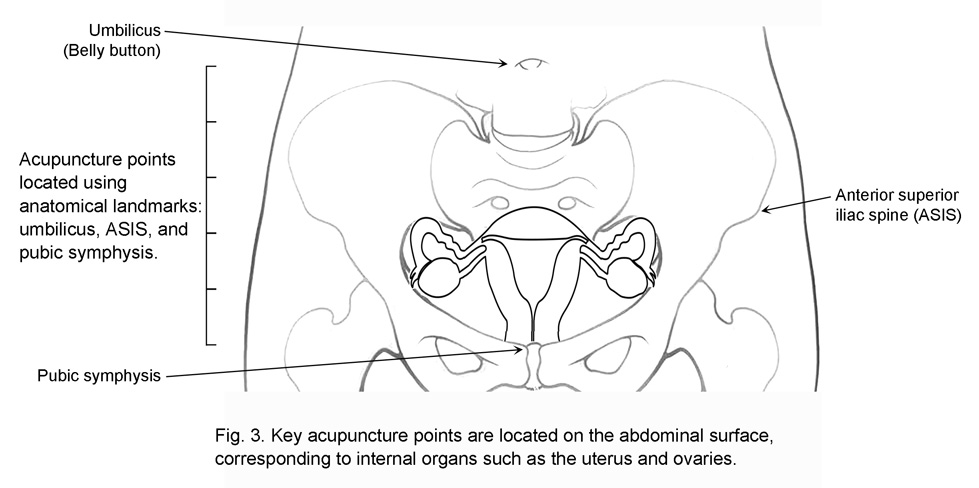
Among the frequently used acupuncture points for women’s health, an important area of point selection is the lower abdomen (Fig. 2). Those abdominal points are mainly located in the area between three anatomical landmarks: the umbilicus, pubic symphysis, and anterior superior iliac spine (ASIS), projected from the internal organs such as the uterus and ovaries (Fig. 3).
In addition to the abdominal points, another area of point selection is located on the back along the spine. This is to stimulate key acupuncture channels to influence the regulation of the nervous, endocrine, and vascular systems on the function of the uterus and ovaries.
Finally, distal points are often selected from acupuncture points located on the four limbs, which are powerful in regulating the acupuncture meridians of the whole body.
Typical examples of Phased Acupuncture Treatment
To better explain the Phased Acupuncture Treatment approach, we will discuss two treatment examples: one addressing menstrual cycle-related conditions and the other addressing IVF.
1. Phased acupuncture treatment for menstrual cycle-related conditions, such as endometriosis, uterine fibroids, polycystic ovary syndrome (PCOS), dysmenorrhea, Irregular menstruation, and premenstrual syndrome (PMS)
Due to the complexity of the menstrual cycle’s physiology, as discussed above, it usually takes 2 to 3 menstrual cycles to alleviate clinical symptoms. This means that a good treatment lasts several months, given a typical 28-day menstrual cycle.
As to the treatments during each menstrual cycle, we have adopted a 4-session treatment plan that is designed to address the different physiology of the following four menstrual phases: menstrual flow phase, proliferative phase (uterine lining grows), first half of secretory phase (uterine lining receptive window), and second half of secretory phase (transition to the next menstrual cycle). Please refer to the following table (Table 1) for detailed treatment phases and their therapeutic objectives, and the selection of acupuncture point areas.
| Acupuncture treatment weeks | Treatment strategy | Areas of acupuncture treatment |
| Week 1 (Menstrual flow) | Promote blood flow to aid complete uterine lining shedding | Points on the limbs and abdomen |
| Week 2 (Uterine lining grows) | Promote blood flow into uterus for optimized uterine lining thickening and into ovaries for optimized follicle growth | 1) Points on the back 2) Points on the abdomen 3) Points on the limbs 4) Additional modalities |
| Week 3 (Uterine lining receptive window) | Promote blood flow into uterus for optimized gland secretion for the reception of embryo | 1) Points on the abdomen and limbs 2) Additional modalities |
| Week 4 (Pre-menstrual flow) | Promote transition into menstrual flow (Reduce uterine contraction for IVF) | Points on the abdomen and limbs |
Table 1. Phased treatment for conditions related to menstrual cycle.
This is a four-week treatment plan for one menstrual cycle; a total of three continuous menstrual cycles are recommended, during which the acupuncturist will adjust the acupuncture points and treatment modalities based on symptom relief.
2. Phased acupuncture treatment for IVF
In vitro fertilization (IVF) is a complex treatment that retrieves mature egg cells from the ovaries, completes fertilization in the lab to generate embryo(s), and implants the resulting embryo(s) into the uterine lining to establish a pregnancy.
The principle of acupuncture treatment for IVF patients is to conduct acupuncture treatments to complement patients’ existing medicated or natural IVF treatment.
A typical IVF treatment has its own phases, including the suppression phase, stimulation phase, egg retrieval phase, pre-embryo transfer phase, embryo transfer event, and post-embryo transfer phase. These phases are based on the physiological phases of the menstrual cycle but are designed to obtain multiple, mature egg cells and increase the successful survival rate of the implanted embryo. Consequently, based on both clinical practice and clinical research findings, we have developed the following phased treatment protocol for IVF patients.
| Acupuncture treatment phases | Treatment strategy | Areas of acupuncture treatment |
| Preparation phase (2 to 3 continuous menstrual cycles) (This phase includes the IVF cycle – suppression phase.) | Promote blood flow into uterus and ovaries and regulate the nervous system to address the underlying pathological changes | 1) Points on the back 2) Points on the abdomen 3) Points on the limbs |
| IVF cycle – Stimulation phase | Promote blood flow into uterus for optimized uterine lining thickening and into ovaries for optimized follicle growth | 1) Points on the back 2) Points on the abdomen 3) Points on the limbs |
| IVF cycle – Ovulation phase | N/A | N/A |
| IVF cycle – Pre-embryo transfer phase | Promote blood flow into uterus for optimized gland secretion for the reception of embryo (One treatment within 24 hours prior to the embryo transfer is highly recommended.) | Points on the abdomen and limbs |
| IVF cycle – Post-embryo transfer phase | Regulate the nervous system to reduce uterine contraction to aid the implantation process of the embryo (One treatment within 24 hours post the embryo transfer is highly recommended.) | Points on the limbs and head |
| Pregnancy phase (acupuncture as needed) | Address any clinical symptoms related to the pregnancy | Based on the clinical symptoms |
Table 2. Phased treatment for conditions related to pregnancy, especially IVF.
This is a multiple-month treatment plan that is phased to compliment an IVF treatment, either medicated or natural.
Factors that influence the acupuncture treatment outcome
While many factors can affect the clinical outcome or effects of acupuncture treatments on women’s diseases, the following are some main aspects to consider.
- The treatment of a patient with her doctor(s)
- Clear communication with the acupuncturist before a formal treatment course
- Good understanding of the benefits and limitations of the role of acupuncture in treating women’s conditions before a formal treatment course
- Selection of an appropriate, licensed acupuncturist
- Persistence in completing the advised treatment course, which may last months for ideal outcomes
- Well management of lifestyle, such as diet, exercise, sleep, and emotion, among others
- Support from family members
Use of Chinese Herbs for women’s conditions
The combinational use of Chinese herbs and acupuncture was emphasized by Simiao Sun, a TCM physician who lived in the Tang Dynasty and is one of the most renowned TCM physicians: “If only acupuncture without Chinese herbs or only Chinese herbs without acupuncture, a TCM physician is not an excellent doctor.” (Simiao Sun, (652 C.E.). Prescriptions Worth a Thousand in Gold.)
At our clinic, we utilize high-quality Chinese herbs to complement our acupuncture treatment. Chinese herbs are taken orally in the form of soup or tea and are regulated as dietary supplements by the US FDA. We have used long-tested traditional Chinese herb formulas and have benefited patients with various disorders, including women’s diseases, digestive diseases, and autoimmune disorders.
Within the scope of practice of a licensed acupuncturist, we carefully customize the use of Chinese herbs based on each patient’s TCM pattern differentiation. More importantly, our customized use of Chinese herbs can serve as a synergistic approach along with our acupuncture treatment protocols. Together, the goal is to achieve the best clinical outcome.
Our treatment approach as part of integrative medicine
Most patients with women’s conditions have their regular treatment with their doctors. We highly recommend that each patient receive treatment from their doctor(s). At the same time, we highly recommend the use of acupuncture to complement their regular treatment(s) and achieve the best clinical outcome in relieving their symptoms of women’s conditions. Together, one can achieve excellent medical care within the current integrative medicine paradigm.
At Precision Acupuncture Clinic, we strive to provide high-quality acupuncture treatments supported by our extensive clinical experience and cutting-edge published research to achieve the best possible therapeutic outcomes for our patients.
Dr. Zhou’s availability:
If you have any issues with booking an appointment at your convenient time, please do not hesitate to contact us at (929)688-2567 or info@precisionacupunctureclinic.com. We will do our best to accommodate you.
We are located at
90 North Broadway
Suite 211
Irvington, NY 10533